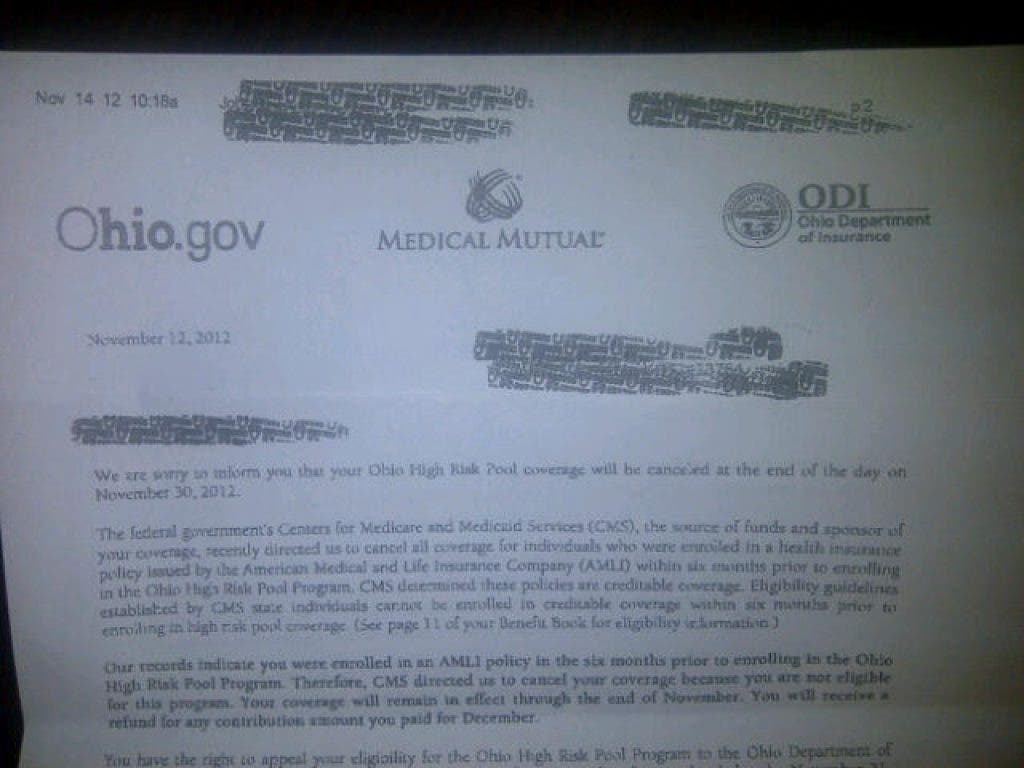
The letter came from The State of Ohio, The Ohio Department of Insurance, and Medical Mutual. Good news never comes with that many names on the top of the letter.
We are sorry to inform you that your Ohio High Risk Pool coverage will be canceled at the end of the day on November 30, 2012.
The letter was dated November 12, 2012.
Some of the unhealthiest residents of the State of Ohio were being tossed off their insurance policy, the Ohio High Risk Pool. In less than three weeks they would no longer be insured. And nobody is standing in line to cover them. How could this happen?
The Ohio High Risk Pool is part of the Patient Protection and Affordable Care Act(PPACA). A stop gap measure, the states were charged with the duty of offering coverage for the chronically uninsured suffering from significant preexisting conditions. The federal government also provided five billion dollars of which Ohio received $152,000,000 for the four year program.
To qualify for the Ohio High Risk Pool you must prove:
- Citizenship
- That you have not been credible insurance coverage for at least six months
- That you have been declined by two insurers within the last six months
- You may skip #3 if your medical records show that you have a major illness that would have gotten you declined
You can not have had credible insurance coverage in the six months leading up to your application for coverage under the Ohio High Risk Pool. This is a federal requirement. Neither the State of Ohio nor Medical Mutual of Ohio, the insurer running our plan, has anything to do with this rule. Some people who are not easily insured have purchased supplements, a better than nothing option. If something happened while they were attempting to find real insurance or qualify for an affordable program, these responsible people were trying to do what they could.
My friend Dave is a conscientious insurance agent. He took a letter from American Medical and Life Insurance Company (AMLI) to the Ohio High Risk Pool. The letter, dated February 11, 2011 was sent to clients to advise them that their policy was no longer HIPAA credible coverage. Dave verified that since the AMLI CoreValue policy was no longer credible coverage, his clients, including family members, could retain this minimum semblance of coverage until they had six months of no real insurance and could enter the Ohio High Risk Pool. NO PROBLEM.
It is those people, those responsible people who attempted to have some coverage, no matter what, who are being kicked to the curb. The letter from the State specifically notes:
Our records indicate you were enrolled in an AMLI policy in the six months prior to enrolling in the Ohio High Risk Pool Program. Therefore, CMS directed us to cancel your coverage because you are not eligible for this program.
The PPACA is a poorly written law. We know that. Worse, the rules and regulations are being written on the fly. What complies one day is non-compliant the next. We went through this with the grandfathering rules. The costs, both human and financial, can’t possibly be calculated.
The Ohioans being kicked out of the High Risk Pool did nothing wrong. They followed the rules of that moment. We are talking about individuals who are gravely ill. What do they do now?
When I became uninsured in June of 2010, an independent agent tried to sell me on purchasing a CoreValue policy. After "Googling" CoreValue and learning about the complaints registered against them, I said "no way!" They are not real insurance and pay so much less on claims than what many people realize. I am not an expert on this exact situation, but all I can say is for people to please do their homework!! If in doubt, contact the Ohio High Risk Pool to learn more and write down names and dates too for your discussion. The agent involved here who promised that it should not be a problem to enroll in the Ohio High Risk Pool got it wrong; maybe innocently so. However, please don't lay all of the blame on the Affordable Care Act! CoreValue Medical has been a 'bad apple', and in states like Washington and New York their department of insurance officials have dealt with them harshly. What more people need to realize is that before the ACA all Ohio had to offer someone losing their creditable coverage was "Open-Enrollment" Plans with monthly premiums that range over $1,000 to $2,000 a month; especially for older folks. Hopefully with the exchanges in 2014 more affordable options will emerge.
http://www.corevaluemedical.com/default/index.cfm/plans-and-benefits1/#eligibility "**These limited benefits plans are underwritten by American Medical and Life Insurance Company and are subject to the company’s underwriting guidelines, exclusions, limitations, terms and conditions of coverage as set forth in the insurance policy and certificate issued which include a pre-existing condition limitation and other restrictions. This insurance is not basic health insurance or major medical coverage, and is not designated as a substitute for basic health insurance or major medical coverage. This is a limited medical benefits plan that provides benefits with limits defined by covered type of medical care or procedure. The limitations are disclosed in the certificate of coverage which is a part of the member kit made available shortly after completion of enrollment."
SOURCES: http://www.complaintsboard.com/complaints/core-value-medical-plan-pennsylvania-c344257.html http://www.complaintsboard.com/complaints/american-medical-life-insurance-co-florida-c342781.html
Lyn - Grandfathered policies may be less than current contracts. The colonoscopy you cited is $3500 and it isn't getting cheaper. That is part of the difference.
A gravely ill person certainly would not be getting much coverage for their serious illness by being enrolled in CoreValue Medical. It just might have been better to go uninsured if the parties involved qualified for some assistance. Many facilities like the Cleveland Clinic for example offer significant help, as you know, even if your income is over the FPL. I went uninsured for six months and had both types of experiences, good and bad.
Being uninsured forces a person to look for creative ways to qualify for other types of help even if they don't qualify for Medicaid. Cleveland Clinic, as one example, offers help even for those 400% over the FPL: Source: http://my.clevelandclinic.org/patients-visitors/billing-insurance/financial-assistance.aspx Hopefully, one year from now as 2014 approaches, and Americans know shortly they will no longer be denied from enrolling in legitimate, affordable (we hope it will be!) and worthwhile (no longer $5 to $10 thousand dollar deductible plans with $50 co-pays at specialists) health insurance plans, the future will be brighter. It can be a long and arduous time when you need to patch together your life as best you can when your insurance options are quite limited. Not understanding poorly worded details can lead someone to making wrong choices for handling their health care needs.
Then there will no longer be a need for scams to operate or the extremely expensive "Open-Enrollment" plans we have had in place here in Ohio where monthly premiums can be over $2,000 a month that prevent most uninsured people from enrollining in them due to the unafforadably high cost.
I recently watched someone sweat out the six months. It was a nerve wracking experience for her. The whole six months with no coverage business has put more than a few people in a bind.
It doesn't hurt for people to explore all of their options; to me there is no shame in it. Facilities that offer extra help are there for those who qualify. We don't always know if we qualify until we apply. Again, I feel there is no shame in applying if the program is available. I was run through the Medicaid system and denied so I knew my status, but the extra help can mean a lot to someone who is uninsured and still not eligble for the high risk pool. Being uninsured may mean only a six month period, which can be long for some and yet considered a short period for the long-term uninsured. The main thing is not to enroll in a program that is truly a scam like CoreValue.
I did apply in the private insurance market weeks prior to when my COBRA coverage would end stating I desired a coverage start date to commence the day after COBRA ended. Believe me I was working ahead and keeping my nose to the grindstone with this issue so hopefully I would give myself the best chance to have a seamless coverage from COBRA to private insurance since I did not have another job with employer-sponsored health insurance. I applied mainly by accessing the website: ehealthinsurance.com. I applied to 4 different carriers: Celtic, Aetna, Anthem, Medical Mutual. One by one, I started receiving my replies. Most determination notices came right to my in-box, others by regular mail. In all cases, I was rejected for coverage due to having pre-existing health conditions. I was told that when you are first rejected, you are most likely to face denial for coverage by other private insurers, and that was true for me. So, yes, you can apply for health insurance prior to losing COBRA coverage. I believe most carriers would request you submit your HIPAA letter to them to prove your previous 18 months of creditable coverage which COBRA will provide to you after your coverage with them ends. Lyn, I certainly do not consider myself an expert, just someone who has lived through some of the experiences connected with losing employer-sponsored health insurance and found it difficult to obtain a viable affordable replacement plan.
Yes, the exchanges will not come onboard until January of 2014 unfortunately when adults can no longer be denied insurance coverage due to having pre-existing conditions. If you were only on the Ohio High Risk Pool 4 months, that is less than 18 months, so I'm not sure how much that will work to help you obtain new coverage. Obviously, since you have been on the Ohio HIgh Risk Pool I'm sure you were denied coverage in the private market. I would contact all those whom you think can help you, Sandy, at this point it seems you would have nothing to lose.
They were cancelled not because of anything they did wrong, but by a misunderstanding within HHS of the definition of Credible Coverage. The good news is that HHS renstated their coverage and my faith in the system. This was never a question of was the Core Value any good. It is not a Major Medical Plan. Not Credible coverage under PPCA laws and was used only to bridge the 6 month gap required by law to qualify for the OHRP. These policy holders have coverage again and that is all that matters. The system will work for and protect them as promised.
That is great news. I know that you and other agents spent an incredible amount of time and energy to get this error reversed. And yes, it is important to note and thank the people at HHS and the Ohio Dept of Insurance for sticking with this and finding a solution. As anyone working in the senior market knows, there are more than a few glitches in the system. The Patient Protection and Affordable Care Act minimizes an agent's function to that of a Navigator, someone who will point the consumer in the right direction. That would be like saying that the main duty of a Congressman is to appear on Sunday morning talk shows.
The best news is that starting 2014, when the marketplace exchanges begin, and the Ohio High Risk Pool sunsets, people seeking private insurance who are not able to obtain health insurance any other way, will no longer be shut out due to having pre-existing health conditions.
http://www.politico.com/story/2013/01/feds-ohio-in-dispute-over-high-risk-pool-eligibility-86036.html http://www.politico.com/story/2013/01/feds-ohio-in-dispute-over-high-risk-pool-eligibility-86036_Page2.html
I just saw this news story today. So, was this decision reversed again??? See link below. http://www.politico.com/story/2013/01/feds-ohio-in-dispute-over-high-risk-pool-eligibility-86036.html http://www.politico.com/story/2013/01/feds-ohio-in-dispute-over-high-risk-pool-eligibility-86036_Page2.html